Smarter Sound, Scalable Design: Introducing the PAMS58xx Digital Amplifier Series

By Abhinay Dwadasi, Intern Product Marketing Engineer
Today’s audio system design challenges go beyond raw power. Engineers are now tasked with delivering consistent sound quality, high thermal efficiency, and precise control. All these demands must be met while maintaining a compact and cost-sensitive design. Today, traditional analog amplifiers, while once sufficient, might now fall short of meeting these evolving demands.
Digital input amplifiers are hence rapidly becoming the product of choice for modern audio systems. These devices offer a direct signal path from source to speaker, enabling precise control, reduced noise, and seamless integration with today’s digital ecosystems. They simplify system architecture, reduce the need for external DSPs, and unlock new levels of tuning flexibility while maintaining high audio fidelity.
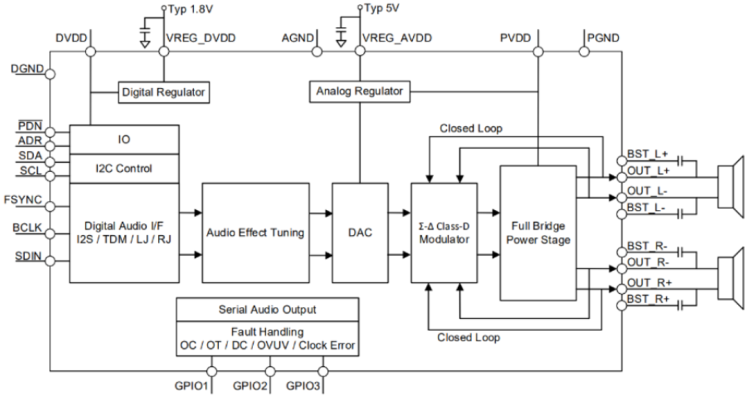
Figure 1: Functional Block Diagram of a Fully Integrated, High-Efficiency PAMS58xx Series Audio Amplifier
With integrated digital interfaces, advanced signal processing, and scalable power options, the PAMS58xx series empowers designers to build smarter, more efficient audio systems across a wide range of applications.
What Undermines Audio Quality in Today’s Compact Designs?
A robust design tailored to a specific application should strike the perfect balance between performance, efficiency, and integration. Even with the best-in-class design aids, there are three persistent challenges that stand in the way of delivering consistent and high-quality sound. Let’s examine how these challenges manifest in real-world performance metrics.
Clipping Distortion at Higher Volumes
Clipping occurs when an amplifier is asked to deliver more output than it can handle. The tops and bottoms of the audio waveform get ‘clipped’, resulting in a harsh, distorted sound.
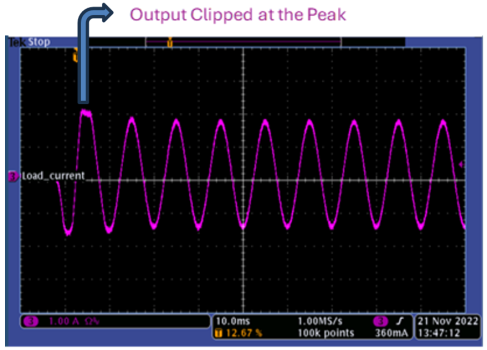
Figure 2: Clipping Distortion observed in the Output at Higher Volume
How to measure it: It can be measured by examining efficiency (the ratio of power converted to sound versus heat) and thermal performance (the temperature increase of the device under load). Poor thermal handling can lead to throttling or shutdowns.
Why it matters: In space-constrained designs, such as TVs or soundbars, thermal headroom may be limited. Without adaptive power control, designers must over-engineer cooling systems, thereby increasing implementation costs and complexity.
Rigid Power Handling at Higher Temperatures
Many traditional amplifiers operate with fixed power rails. This limits their ability to adapt to changing audio demands and thermal conditions, especially in compact enclosures.
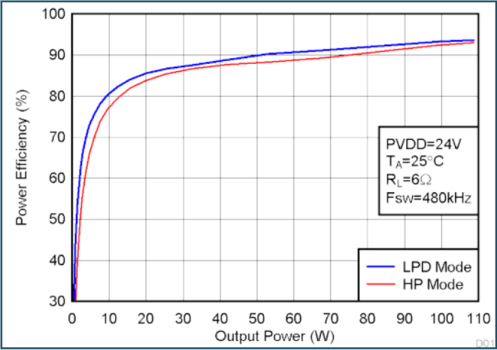
Figure 3: PAMS5827 Amplifier Performance Across Output Power Levels
How to measure it: It can be measured by examining efficiency (the ratio of power converted to sound versus heat) and thermal performance (the temperature increase of the device under load). Poor thermal handling can lead to throttling or shutdowns.
Why it matters: In space-constrained designs, such as TVs or soundbars, thermal headroom may be limited. Without adaptive power control, designers must over-engineer cooling systems, thereby increasing implementation costs and complexity.
Limited Tuning Flexibility
Every speaker enclosure has unique acoustic characteristics. Without flexible tuning, mismatches between amplifier output and speaker behavior can result in muddy or unbalanced sound.

Figure 4: Comprehensive Audio Signal Processing Chain: From I2S Input to Output Mixer
How to measure it: This is often addressed through equalization (EQ) and dynamic range control (DRC). EQ allows precise tuning to match the audio profile to a particular application or desired sound. In contrast, DRC ensures consistent loudness by compressing peaks and lifting quieter parts, improving the overall sound quality. These tools enable designers to shape the sound (including timbre and tonality) and maintain consistent loudness across content types.
Why it matters: External DSPs can provide tuning, but they add cost, complexity, and board space. Integrated (EQ+DRC) solutions like PAMS5827 are more efficient and scalable.
A Timely Answer to Modern Audio Design Constraints
Where many solutions in the market force trade-offs between power and efficiency, flexibility and integration, or performance and cost, the PAMS58xx series is engineered to remove those compromises. It combines advanced signal processing, intelligent power control, and high-fidelity audio performance in a compact, pin-compatible lineup that scales with your design requirements. Let’s dive into how the PAMS58xx series solves every one of the above constraints to deliver the best audio experience.

Figure 5: The PAMS58xx Pin-to-Pin Compatible Series of Digital Amplifiers
Eliminate Clipping with Smart Feedback Control
Clipping is one of the most common and most damaging forms of distortion in audio systems. The PAMS58xx series addresses this issue with Automatic Gain Limiter (AGL) and Dynamic Range Control (DRC) real-time feedback mechanisms that adjust gain and compression to prevent clipping before it occurs. The result is an ultra-low THD+N of 0.02%, ensuring clean, consistent audio even at higher volumes.
Smarter Power Management with Class H
In compact designs, thermal headroom is limited, and traditional fixed-rail amplifiers often waste energy as heat. The PAMS58xx series uses 16-step Class H power control, dynamically adjusting the supply voltage to match the audio signal’s demands. For example, if the main PVDD range for the power stage of the digital input amplifier is 9V-16V, then the audio signal is tracked in 16 discrete steps (9V, 9.466V, 9.933V, 10.399V, 10.866V, 11.333V, 11.799V, 12.266V, 12.732V, 13.199V,14.132V, 14.599V, 15.065V, 15.532V, 15.999V). This translates directly into higher efficiency, improved thermal performance, and extended battery life. The result is an efficiency of over 90% efficiency, reduced heat generation, and higher output power without the need for bulky heatsinks.
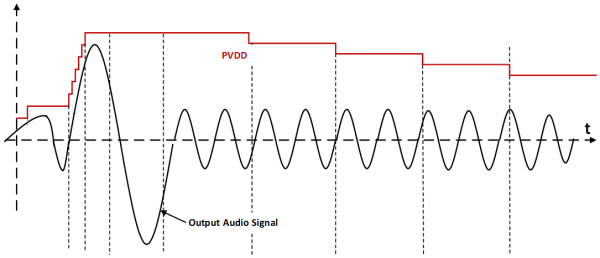
Figure 6: Class-H Control: PVDD Stepping in Sync with Output Audio Signal
Built-in DSP for Flexible Tuning
Audio tuning is often one of the most time-consuming and resource-intensive parts of system design, especially when it requires external DSPs or custom firmware. The PAMS58xx series simplifies this with a programmable DSP that includes multi-band EQ, tone tuning, 3D effects, and DRB—all built directly into the amplifier. This high level of integration results in faster development time, lower BOM cost, and consistent sound quality across product lines.
Why the PAMS58xx Series Stands Out
In a landscape where many competing solutions require PCB redesigns for different power levels or lack integrated tuning capabilities, the PAMS58xx series stands out. With pin-to-pin compatibility across the whole series, firmware-based scalability, and industry-leading audio specs, it fills a critical gap in the market, offering flexibility without complexity.
Here are some key differentiators of the PAMS58xx series:
Pin-Pin Compatibility across Power levels: Packaged in the TSSOP-28EP (Type TH-1), all five devices (PAMS5803, PAMS5804, PAMS5825, PAMS5826, and PAMS5827) share the same PCB layout. Designers can scale power and DSP features by simply updating firmware.
Integrated DSP with No External Components Required: Built-in EQ, DRC, AGL, and 3D effects eliminate the need for external DSPs, saving board space and BOM cost.
Superior Audio Performance: With THD+N as low as 0.02%, noise under 37µVRMS, and efficiency over 90%, the PAMS58xx series delivers clean, high-fidelity sound that rivals or exceeds many discrete solutions.
Smart Power Management: Class-H support ensures efficient power usage and thermal control critical for thermally constrained enclosures.
Engineered for Today, Future-Proofed for Tomorrow
By combining high-performance audio, integrated DSP, and scalable power options in a single, pin-to-pin compatible platform, the new generation PAMS58xx series Class-D digital input amplifiers from Diodes empower engineers to meet the demands of modern audio systems without compromise. Whether you’re building smart speakers, TVs, or soundbars, the PAMS58xx helps you deliver consistent, high-quality sound with greater efficiency and faster time to market.
The Diodes logo is a registered trademark of Diodes Incorporated in the United States and other countries.
All trademarks are the property of their respective owners.
© 2025 Diodes Incorporated. All Rights Reserved.